1925 Union Valley Road, Hewitt, NJ 07421


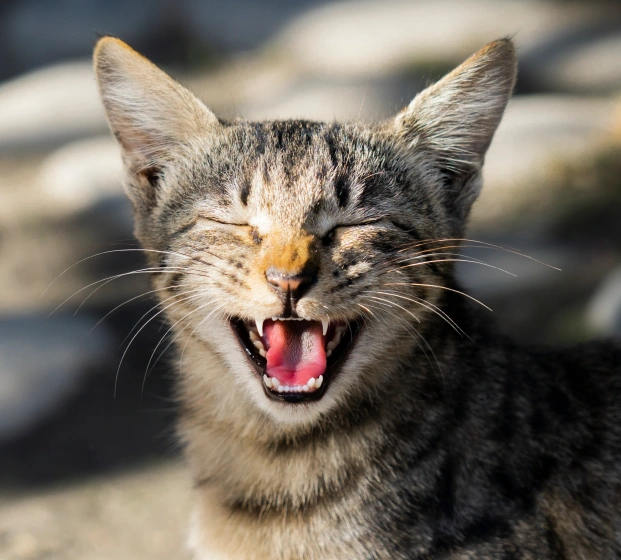

Healthy Teeth, Happy Pets
More than 85% of dogs and cats that are at least 4 years of age have a condition in which bacteria attacks gum tissue. This condition is called periodontal disease.
Although this condition is treatable when caught early, if left untreated can cause serious damage to organs which may result in death. Periodontal disease is preventable; the key to your pet’s oral health is professional veterinary dental care along with a good home dental routine.
Healthy teeth and gums are essential to your pet’s overall well-being. At Greenwood Lake Animal Hospital, we focus on preventive care and early detection to help pets live longer, happier lives.

Your Pet's Dental Report Card
NICE JOB! No sign of plaque or tartar - Home dental care is needed to maintain these healthy teeth and gums. Brushing your pet’s teeth regularly is ideal; the use of CET pet toothpaste is highly recommended. If brushing your pet’s teeth is not an option, then dental chews such as Blue Chews from Vetradent, Bright Bites dental treats and Greenies dental chews help reduce plaque and tartar from forming on teeth. Dental diets such as Hill’s t/d or Royal Canin DD diets are recommended along with the anti-plaque water additive Healthy Mouth.
Grade I / Mild Gingivitis
Margins of attached gum is inflamed and swollen. You may notice a thin red line along the gum line. At this point plaque is beginning to cover the teeth. Dental cleaning is indicated within 6 months.
Grade II / Moderate Gingivitis
The entire gum is inflamed and swollen. Mouth is painful and odor is noticed. May have gum pockets allowing bacteria to flourish. Moderate amounts of plaque buildup. Dental cleaning to remove tartar is needed within the next 30 days. Addition of tartar control diet and home dental care needed afterward for prevention.
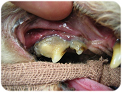
Grade III / Severe Gingivitis
Early Periodontal disease is marked by red and bleeding gums. Gum is damaged by infection and tartar. Mouth is painful and bad breath odor is evident. Dental cleaning to remove tartar is needed immediately. Deep gingival pockets may lead to the extraction of teeth. Addition of tartar control diet and home dental care needed to prevent recurrence.
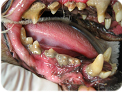
Grade IV / Established Periodontal Disease
Chronic infection destroys the gum, tooth and bone. Mouth is painful. Bacteria spread though the body via the bloodstream and may damage the kidneys, liver and heart. Dental cleaning to remove tartar is needed immediately. Teeth are loose and in need of extraction and gum suturing. Home dental care afterward is necessary for prevention / recurrence of disease.

Dental Cleaning by Your Veterinarian
To prevent dental disease, your pet needs routine dental care at home. But to perform good home care, you need to start with clean teeth. Brushing will remove plaque but not tartar. So if your pet’s teeth have tartar, it is necessary for your veterinarian to remove it and polish the teeth. A routine dental cleaning consists of:
- Pre-op bloodwork to evalulate organ function and complete blood counts.
- Anesthetizing your pet.
- Taking radiographs (x-rays) to assess the health of all of the teeth and bones of the mouth.
- Flushing the mouth with a solution to kill the bacteria.
- Cleaning the teeth with handheld and ultrasonic scalers. All calculus is removed from above and below the gumline. This is extremely important and can only be done if your pet is under anesthesia.
- Polishing the teeth to remove microscopic scratches.
- Inspecting each tooth and the gum around it for any signs of disease. Any necessary extractions.
- Flushing the mouth, again, with an antibacterial solution.
- Finishing with a fluoride treatment.
- Recording any abnormalities or additional procedures on a dental chart.
- Determining the best follow-up and home dental care program for your pet.
Flip your pet’s lip and check out your pets oral health. It is never too early or too late to begin the journey toward good oral health. The veterinarians at Greenwood Lake Animal Hospital are your pet’s dentist. The doctors are assisted by highly trained dental technicians. Additionally, our hospital has a dedicated dental suite equipped with digital x-ray, hydraulic wet lift table and state-of-the art monitoring equipment and anesthesia equipment.

Home Dental Routine
At-home dental care helps maintain clean teeth between visits. Regular brushing can significantly reduce plaque and tartar buildup.
Brushing Your Dog’s Teeth
Brushing your dog's teeth should not be a chore for you or your dog. Instead, it should be an enjoyable time for both of you. If you take things slowly at the beginning and give lots of praise, you and your dog will start looking forward to your brushing sessions. But first, we need to gather together what we will need.
- Toothpaste There are many pet toothpastes on the market today. Make sure you use a pet toothpaste. Toothpastes designed for people can upset your dog's stomach so please do not use any human toothpastes, containing fluoride, on your pet. Flavored pet toothpastes can make toothbrushing more acceptable to pets.
- Toothbrushes or gauze pads/sponges The real benefit of toothbrushing comes from the mechanical action of the brush on the teeth. Various brushes, sponges and pads are available. The choice of what to use depends on the health of your dog's gums, the size of your dog's mouth, and your ability to clean the teeth. Use toothbrushes designed specifically for pets – they are smaller, ultra-soft, and have a somewhat different shape. Finger toothbrushes that do not have a handle but fit over your finger may be easier for some people to use. Pet toothbrushes can be purchased through your veterinarian, or some pet stores. For some dogs, starting out with gauze pads/sponges may be helpful since they are more pliable. Gauze pads/sponges can be wrapped around your finger and are softer than brushes.
Where to begin. Number one, this should be fun for you and your dog. Be upbeat and take things slowly. Do not overly restrain your dog. Keep sessions short and positive. Be sure to praise your dog throughout the process. Give yourself a pat on the back, too! You are doing a great thing for your dog!
- First, have your dog get used to the taste of the toothpaste. Pet toothpastes have poultry, malt, or other flavor so your dog will like the taste. Get your dog used to the flavor and consistency of the toothpaste. Let your dog lick some off your finger. Praise your dog when he licks the paste and give a reward (really tasty treat). If your dog does not like the taste of the toothpaste, you may need to try a different kind. Continue this step for a few days or until your dog looks forward to licking the paste.
- The next step is to have your dog become comfortable with having something placed against his teeth and gums. Apply a small amount of paste to your finger and gently rub it on one of the large canine teeth in the front of the mouth. These are the easiest teeth for you to get at and will give you some easier practice. Be sure to praise your dog and give a tasty treat or other special reward (e.g., playing ball).
- After your dog is used to the toothpaste, and having something applied to his teeth, get him used to the toothbrush or gauze pads/sponges you will be using routinely. We need to get your dog used to the consistency of these items, especially the bristles on a brush. So, let your dog lick the toothpaste off of the brush so he gets used to the texture. Again, praise your dog when he licks the paste and give a really great treat or other reward. Continue this step for about a week, making sure your dog readily licks the paste off of the brush.
- Now your dog is used to the toothbrush and toothpaste and having something in his mouth. So the next step is to start brushing. Talk to your dog in a happy voice during the process and praise your dog at the end. Lift the upper lip gently and place the brush at a 45º angle to the gumline. Gently move the brush back and forth. At first, you may just want to brush one or both upper canine teeth. You do not need to brush the inside surface of the teeth (the side towards the tongue). The movement of the tongue over the inside surfaces keeps them relatively free of plaque. Be sure to praise your dog, end on a good note and give a tasty treat or other great reward.
How Often?
Certainly, the more often you brush the better. Always aim for daily dental care for your dog, just as you aim for daily dental care for yourself. The hardest thing about home dental care for dogs is just getting started. Once you have done it for a while, it just becomes part of your daily routine. If you cannot brush daily, brushing every other day may remove the plaque before it has time to mineralize. This will still have a positive effect on your dog's oral health.
Other at Home Dental Alternatives:
- Food - Studies show that hard kibbles are slightly better at keeping plaque from accumulating on the teeth. There is veterinary dentist-approved food on the market called t/d made by Hill's, the Science Diet people. Research studies have shown that pets eating this food have less plaque and calculus build-up. This food is available through your veterinarian. Avoid feeding dogs table scraps or sweet treats because they can increase the build up of plaque and tartar, and can lead to other health problems.
- Treats - There are some dental chews on the market that are specifically designed to help control plaque and tartar buildup. These dental chews are accepted by the Veterinary Oral Health Council (VOHC) and have earned their seal of approval. GWLAH recommends Bright Bites dental treats, Blue Chews dental chews and Canine Greenies dog chews.
- Water Additive - Healthy Mouth Anti-Plaque Water Additive.
Accepted by the Veterinary Oral Health Council and has earned the VOHC seal of approval, is found at https://www.healthymouth.com/Articles.asp?ID=246.
Healthy Mouth is clinically proven to reduce plaque that leads to gingivitis by 71.9 % and 76.7 % in two clinical trials. Healthy Mouth has 100 % natural ingredients with organic actives including papain (a highly effective enzyme derived from papaya) pomegranate and blueberry, powerful anti-oxidants and yucca selected for its deodorizing and antibacterial properties.